

Ask ten service business owners in Accra or Lagos how they arrived at the price on their last quote.
Most won't be able to walk you through it.
"That's about what people charge."
"I added a bit for stress."
It's not that they're bad at business.
It's that nobody ever showed them a repeatable way to price a job.
That gap is expensive.
Underpricing quietly drains cash from businesses that look busy but never seem to grow.
Overpricing without justification loses jobs to competitors who do have a system, even if that system is barely more than a confident guess.
Quick answer
To price a service job in Ghana or Nigeria, add up five things: direct costs (materials, fuel, parts), labour costed at a real hourly rate, a fair share of your overhead (rent, data, tool wear, transport), a margin of around 15-25% for profit and growth, and a buffer for local risk factors like currency shifts and power cuts. A quote built from these five parts holds up when a customer asks how you got the number — a flat "materials plus a guess for labour" quote usually doesn't. A pricing calculator can build this breakdown for you automatically instead of doing the maths by hand on every job.
Why "Google Calculator" isn't a pricing tool
Search "calculator" and you'll land on Google's built-in calculator, or an app that does addition, subtraction and percentages.
That's fine for splitting a bill.
It's not built for pricing a job, because pricing isn't really a math problem — it's a decision problem.
A basic calculator can tell you that 6 hours times ₵50 is ₵300.
It can't tell you whether ₵50 an hour actually covers your fuel, your tools wearing out, the jobs that fall through, and a margin that lets you save.
That's the piece most service businesses are missing.
The 5 things a properly priced quote accounts for
A quote you could explain to a customer without flinching includes:
1. Direct costs. Materials, parts, fuel to and from the site — anything you'd have to buy specifically for this job.
2. Labour cost. Your time, valued at a real hourly rate — not a guess, but a number based on what you actually need to earn.
3. Overhead allocation. A slice of your fixed costs — rent, data, tool maintenance, transport — spread across the jobs you expect to do in a month.
4. Margin. The profit on top of costs that lets you reinvest, save or grow. Without this line, you're running a job, not a business.
5. Local risk factors. Currency movement on imported materials, power cuts adding time to a job, informal-market competitors who underquote and then cut corners.
Most quotes only include the first item, and sometimes a rough version of the second.
Items three through five are where the actual profit lives.
A worked example
Take a small repair job: fixing a faulty socket and rewiring a section of a client's living room in Accra.
- Materials: ₵180 (cable, socket, connectors, minor consumables)
- Labour: 4 hours at a real hourly rate of ₵60/hr = ₵240
- Overhead allocation: ₵40 (a fair share of transport, tool wear and data costs for the month)
- Margin (20%): applied to the subtotal of ₵460 = ₵92
- Total quote: ₵552
Compare that to a common alternative: "materials plus a flat ₵300 for labour."
That quote undercharges by roughly ₵152.
Money that just evaporates, job after job, until the business owner wonders why revenue never quite becomes profit.
Turning this into a repeatable process
Doing this math by hand once is manageable.
Doing it accurately for every quote, every week, while also running the job itself, is where most people give up and go back to guessing.
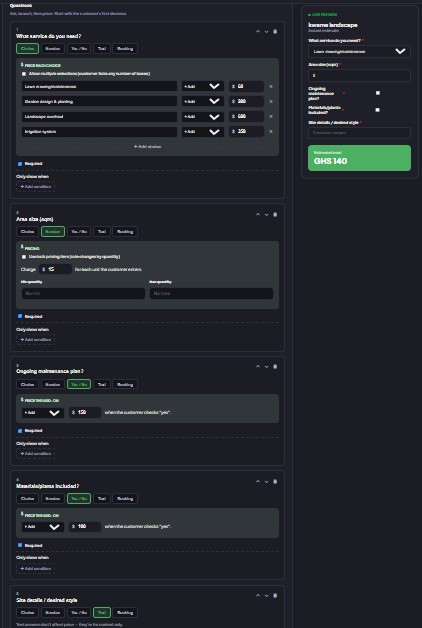
That's the real problem a pricing calculator solves.
Not the arithmetic — the consistency, under time pressure.
Enter your materials cost, hours and target margin, and it builds the same five-part breakdown instantly.
The kind you can show a customer as an itemised quote, rather than a single number they have to trust blindly.
Common pricing mistakes to avoid
Flat-rate guessing. Charging "what feels right" instead of what the job actually costs you, especially as material prices shift.
Underpricing to win the job. A common trap when competition is visible and immediate — but it trains customers to expect below-cost pricing.
Ignoring rework and delays. Power cuts, traffic and client changes all cost time. If they're not priced in, you're absorbing them for free.
Not writing it down. A verbal quote over a WhatsApp voice note has no record, no professionalism signal, and no paper trail if a dispute comes up later.
Where to go from here
If your work is one of the specific trades common across Ghana and Nigeria — electrical work, tailoring, event planning, auto repair — pricing gets more specific than the general framework above, because every trade has its own cost structure and risk factors.
We're publishing dedicated pricing breakdowns for individual trades over the coming weeks, starting with electricians and artisans.
In the meantime, you can build your own reusable pricing calculator, tailored to your trade and your real costs, with the KwoTit CRM.
Frequently Asked Questions
What should a service quote include in Ghana or Nigeria? A properly priced quote includes direct costs (materials, parts, fuel), labour at a real hourly rate, a share of overhead like rent and transport, a margin for profit, and a buffer for local risk factors such as currency movement and power cuts. Most quotes only cover the first item or two, which is where the underpricing happens.
How do you calculate labour cost for a quote? Labour cost is your time multiplied by a real hourly rate — one based on what you actually need to earn to cover your living costs and business goals, not a rate you picked because it "sounds right." Multiply that rate by the hours the job realistically takes, including setup and travel.
What margin should I add to a quote? A margin of roughly 15-25% on top of your direct costs, labour and overhead is a common starting point for small service businesses, though the right number depends on your trade, competition and how much risk the job carries. Without a margin line, a business is covering its costs but not actually generating profit.
Is there a free pricing calculator for service businesses in Ghana and Nigeria? Yes — a pricing calculator built into a tool like KwoTit can take your materials cost, hours and target margin and generate the same five-part breakdown automatically, so you don't have to redo the maths by hand on every quote.
Why do flat-rate quotes ("materials plus a bit for labour") lose money? Flat-rate quotes usually skip overhead, margin and local risk factors entirely, so they undercharge by the exact amount those items would have added. Over many jobs, that gap is the difference between a business that looks busy and one that actually grows.